Synastry: How Astrologers Actually Compare Two Charts
Synastry compares two birth charts to map attraction, friction, and everyday compatibility. Here is how it actually works, beyond sun sign matching.
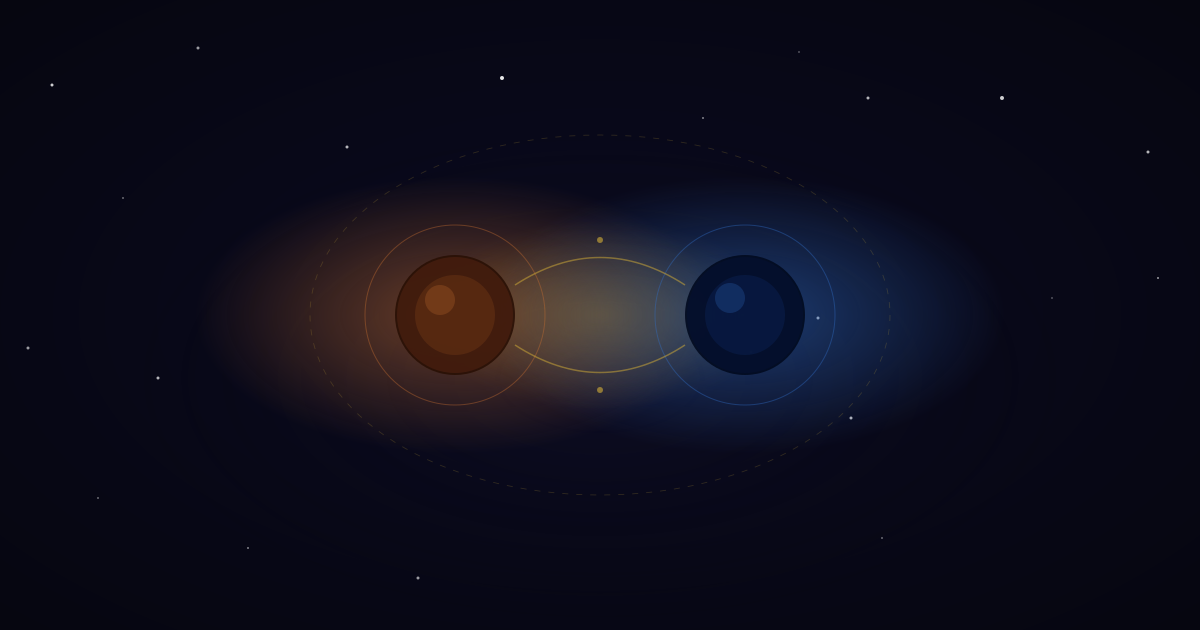
Synastry is the branch of astrology that compares two people's full birth charts to map how they interact, not just whether their sun signs are supposedly compatible. It is the real technique behind serious astrological compatibility reading, and it has almost nothing in common with a "which signs get along" chart you might see in a magazine.
The distinction matters because sun-sign compatibility is a massive oversimplification. It sorts eight billion people into twelve categories based on one placement and ignores the other nine-plus points in a full chart. Synastry works differently: it takes two complete charts and studies how the actual placements interact, planet by planet.
What synastry actually compares
A synastry reading overlays one person's chart onto the other's and looks at two main things.
House overlays. Where do your partner's planets fall in your houses, and vice versa? If someone's Venus lands in your seventh house, the house traditionally associated with partnership, that placement tends to activate romantic themes in a specific, felt way. House overlays describe which areas of each person's life get activated by the other person's presence.
Aspects between the two charts. This is the core of synastry. An aspect is the angular relationship between two planets, measured in degrees, and different angles create different dynamics:
- A conjunction (0 degrees apart) blends two placements closely, for better or worse, since whatever a planet represents gets intensified when another planet sits right on top of it.
- A trine (120 degrees apart) tends to flow easily, since the two placements support each other without much friction.
- A square (90 degrees apart) tends to create tension and challenge, since the two placements pull in different directions and have to be actively reconciled rather than flowing on their own.
- An opposition (180 degrees apart) tends to create a push-pull dynamic, where each person represents something the other needs but does not naturally have.
None of these are automatically "good" or "bad." A trine that flows easily can also mean nothing ever gets challenged or grown. A square that creates friction can also be the exact tension that keeps two people engaged and evolving together, if they handle it well.
A worked example
Say one partner's Mars sits at 5 degrees Aries and the other's Venus sits at 8 degrees Sagittarius. That is roughly a trine, 120 degrees apart within a few degrees of orb, and in synastry terms it describes an easy, energizing pull: Mars's drive and directness meets Venus's warmth and enthusiasm without much friction, often experienced as immediate, uncomplicated attraction. Now imagine the same Mars instead sitting at 5 degrees Cancer, roughly square to that Sagittarius Venus. The same two planets, drive meeting affection, now sit in tension: Mars's more guarded, protective instinct can read as standoffish to a Venus that wants open enthusiasm, and Venus's need for space and exploration can read as inconsistent to a Mars that wants direct engagement. Neither configuration predicts the relationship's success on its own. They describe two different textures of the same underlying attraction, one that needs less active translation and one that needs more.
This is also why a full synastry reading looks at many planet pairs at once rather than any single aspect in isolation, since a chart typically contains dozens of aspects between two people's placements, and the overall pattern, not any one aspect alone, is what actually describes the relationship's texture.
Why synastry goes beyond sun signs
Sun-sign compatibility charts answer one question: do these two core identities theoretically align? Synastry asks a much wider set of questions, because it is working with a much wider set of data:
- Do our Venus placements, which describe what each of us finds attractive and how we express affection, align or clash?
- Do our Mars placements, which describe drive, conflict style, and desire, complement each other or compete?
- Do our Moon placements, which describe emotional needs, understand each other, or constantly miss each other?
- Do our Mercury placements, which describe how we think and communicate, speak a similar language or a genuinely different one?
Two people can have a famously "incompatible" pair of sun signs by pop-astrology standards and still have a synastry chart full of supportive aspects between their moons and Venuses, the placements that actually govern day-to-day emotional and romantic compatibility. Sun-sign matching misses this completely because it only ever looks at one placement out of many.
What synastry is good at describing
Used well, synastry is genuinely useful for naming specific dynamics that are otherwise hard to put into words. It can help explain:
- Why a relationship feels effortless in some areas and requires real work in others, by pointing to which specific placements are trine versus square.
- What each person is drawn to in the other, through the Venus and Mars overlay.
- Where recurring friction is likely to show up, through tense aspects like squares and oppositions between core placements.
- Which parts of life a relationship tends to activate, through the house overlay, whether that is home life, shared finances, communication, or something else.
This is where synastry earns its reputation: not as a verdict on whether two people should be together, but as a map of where the energy in a specific relationship actually concentrates.
What synastry cannot tell you
Synastry describes mechanics, not outcomes. It can show that two charts have a lot of friction-heavy aspects between them, but it cannot tell you whether that friction will be destructive or whether it will be the exact challenge that helps both people grow. That depends on the two actual people: their self-awareness, communication skills, and willingness to work with what the chart describes rather than being run by it.
It is also worth being honest about the limits of the whole framework. Astrology does not have controlled scientific evidence behind it as a predictive system, and a synastry chart full of "difficult" aspects is not a reason to end a relationship any more than a chart full of "easy" aspects guarantees one will last. Two people with objectively harmonious synastry can still be a poor match if their values, life goals, or basic compatibility as people do not line up, and two people with a tense chart can build something excellent if they understand what they are working with.
How to actually use a synastry reading
The most useful way to read synastry is as a vocabulary for patterns you may already sense but have not been able to name. If a relationship keeps hitting the same specific friction point, seeing that pattern reflected in a Mars-square-Mars aspect, for example, does not create the friction. It gives you language for something that was already there, which can make it easier to talk about directly instead of circling it indirectly.
That reflective use is also where moon sign compatibility fits in specifically: the moon-to-moon comparison inside a synastry reading is often the single most practically useful piece, since it describes whether two people's ways of handling stress and needing comfort are actually compatible day to day. If you want to look at your own chart's relationship patterns directly, a structured Destivio reading can walk through what your placements suggest about how you connect with others, without requiring you to learn the full mechanics of aspect interpretation first.
Frequently Asked Questions
Q: What is synastry in astrology? A: Synastry is the technique of comparing two complete birth charts to understand how two people interact, by studying the angular relationships, called aspects, between their planets, along with which houses each person's planets fall into on the other's chart. It is the standard method behind serious astrological relationship compatibility, as opposed to simple sun-sign matching.
Q: Is synastry more accurate than sun sign compatibility? A: Synastry uses far more data, comparing full charts rather than one placement, so it describes relationship dynamics with much more specificity than sun-sign matching can. That said, neither is scientifically validated as predictive, and synastry's value is in the specific, useful language it gives to real patterns, not in guaranteed accuracy.
Q: What are aspects in synastry? A: Aspects are the angular distances between two planets, measured in degrees. Common aspects include conjunctions (0 degrees, intensifying), trines (120 degrees, easy flow), squares (90 degrees, friction), and oppositions (180 degrees, push-pull dynamics). Different aspects between different planet pairs describe different relationship dynamics.
Q: Can synastry predict if a relationship will last? A: No. Synastry can describe where attraction, ease, and friction are likely to show up between two people, but whether a relationship lasts depends on the actual people involved, including their communication, values, and choices. A chart with difficult aspects is not a prediction of failure, and a chart with easy aspects is not a guarantee of success.
Q: Which planets matter most in a synastry reading? A: Venus and Mars overlays are usually central for romantic attraction and chemistry. Moon-to-moon aspects are often the most important for long-term emotional compatibility, since they describe how each person handles stress and seeks comfort. Mercury aspects matter for communication style, and Sun aspects speak to whether core identities and goals align.
Arpit Tripathi
Founder, Destivio · ex-Google · ex-AWS
Arpit built Destivio to bring the depth of Vedic astrology into the age of AI — making precise, personalized birth chart readings accessible to everyone.
LinkedIn →Continue reading
Moon Sign Compatibility: Why It Matters More Than Sun Signs
Sun sign compatibility describes shared goals. Moon sign compatibility describes whether you hand…
Read →Red Flags Aren't in Your Sun Sign
Zodiac red flags green flags aren't in your sun sign. Your Venus sign shows how you love, your Ma…
Read →
Why You Don't Feel Like Your Sun Sign
Feeling like you don't relate to your zodiac sign is the most useful clue in your chart. Here is…
Read →Explore your chart
Curious what your birth chart reveals about you?
Get a personalized reading based on your birth energy — free to start.
Discover your birth energy →