Red Flags Aren't in Your Sun Sign
Zodiac red flags green flags aren't in your sun sign. Your Venus sign shows how you love, your Mars sign shows desire and conflict. Here's the real signal.
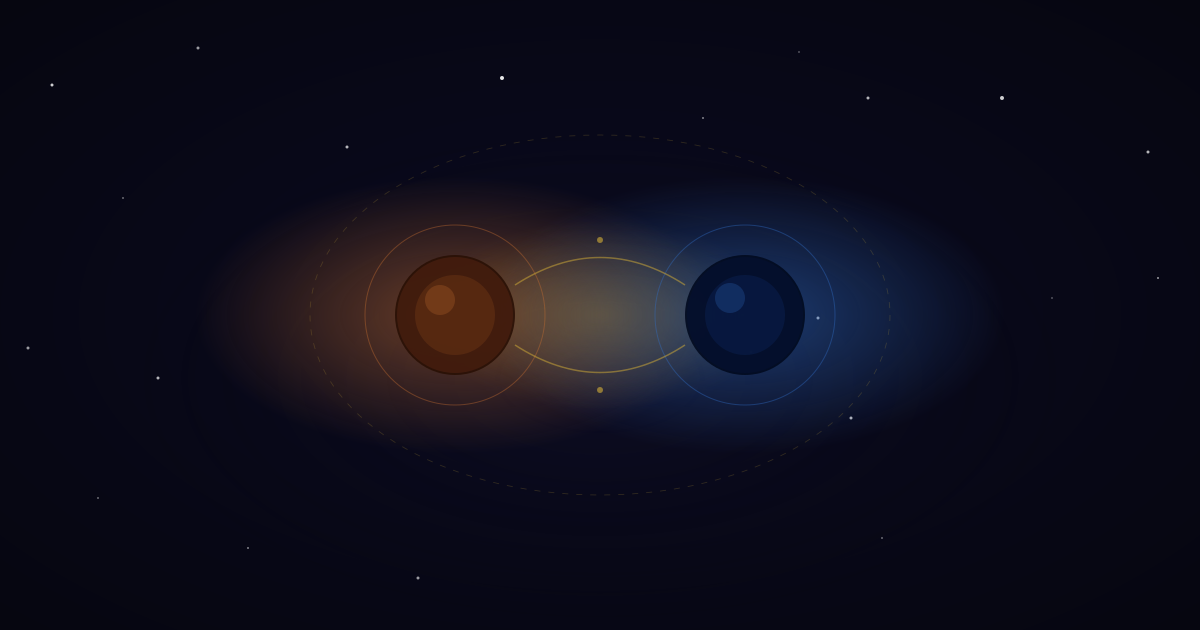
You have seen the lists. "Red flags by zodiac sign." "Green flags every sign gives off." They get millions of shares, and they are almost always wrong about you. Here is a question worth sitting with: why does a sun-sign list describe your friend perfectly and your partner not at all, even though you both know your "signs"? The short answer is that the part of astrology that actually maps to how a person loves and fights is not the sun. The fuller answer is in two planets most of these viral posts never mention: Venus and Mars. This article will show you what each one governs and what tendencies tradition links to them. Your own chart will show you exactly where yours sit.
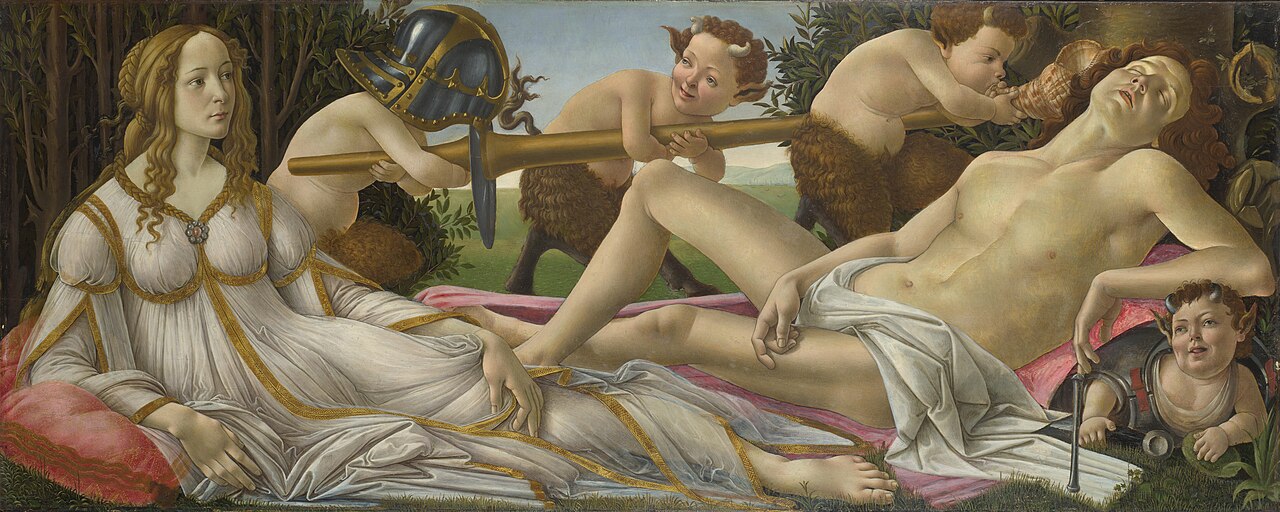 Sandro Botticelli, Venus and Mars (c. 1485), National Gallery, London. Public domain.
Why sun-sign relationship advice is the wrong tool
Your sun sign is one fact about you: the constellation the sun was passing through on your birthday. It is genuinely meaningful in astrological tradition, often read as your core identity, your sense of "I," the thing you are growing toward. What it is not is a complete relationship profile.
Think about what a "red flag by sign" list is actually doing. It takes one of twelve categories, assigns it a personality, and sells it back to you. Of course an Aries description of "impulsive in love" feels true sometimes. It feels true to most people sometimes. That is not a coincidence. It is the same effect psychologist Bertram Forer demonstrated in 1948, when he gave students an identical "personalized" profile and watched them rate it as highly accurate to themselves. We now call it the Barnum effect: vague, broadly flattering statements feel custom-made.
A sun-sign red-flag list feels personal for the same reason a fortune cookie does. It was written to fit everyone, which is exactly why it can't tell you much about you.
This matters because relationships are where people most want astrology to be specific, and the sun is the least specific tool for the job. About 30% of US adults say they consult astrology, tarot, or a fortune teller at least once a year, according to a 2025 Pew Research Center report, and most say they do it for fun. That is healthy. The trouble starts only when someone makes a real decision about a real person based on a list that was never about that person at all.
Venus: how you love, give, and receive
In astrological tradition, Venus describes your love language and your relationship to pleasure, affection, money, and beauty. Where your sun is who you are, your Venus is what you are drawn to and how you express care. It is the part of the chart most directly about "what I find attractive" and "how I want to be loved."
A small piece of astronomy makes Venus easy to find conceptually. Venus orbits closer to the sun than Earth does, so from our view it never strays far from the sun in the sky. It can appear at most about 47 degrees away from it. In chart terms, your Venus sign is always your sun sign or one of the two signs on either side of it. That is why two people with the same sun can still love completely differently: their Venus may sit a sign or two apart, and that gap is often where compatibility lives or fails.
Venus governs the soft questions. Do you show love through words, time, gifts, touch, or acts? Do you want to merge or keep a little independence? Do you romanticize, or do you stay grounded and practical about partnership? None of this is visible from a birthday alone.
Mars: desire, drive, and how you fight
If Venus is how you love, Mars is how you want, chase, and clash. Astrological tradition links Mars to desire, sexual energy, drive, assertion, and conflict style. It is the planet of the verb: pursuing, defending, arguing, initiating.
Mars is where a lot of real relationship friction actually shows up, because conflict style is harder to fake than first-date charm. Some people go hot and loud and want it resolved in the next ten minutes. Some go quiet and cold and need a day. Some avoid the fight entirely and let it leak out sideways. In a chart reading, Mars is the placement people most often recognize with a wince. It tends to describe the thing they already know they do under stress.
Together, Venus and Mars are the classic relationship pair: one for affection and values, one for desire and drive. A "red flag" worth taking seriously is rarely "they're a Scorpio." It is more often a mismatch in how two people's Venus and Mars want to operate, and the good news is that mismatches are workable once they are named.
Green flags and watch-fors by element
Here is the genuinely useful part you can use today, even before you run a chart. Every sign belongs to one of four elements, and the element of someone's Venus and Mars tells you a lot about their relational style. The list below is framed honestly: each element has a real strength (a green flag) and a real edge to watch. These are tendencies astrological tradition associates with each element, not fixed verdicts about a person. Read them as starting questions, not conclusions.
Fire (Aries, Leo, Sagittarius)
Venus in fire is often associated with warm, direct, expressive affection. The green flag: they tell you how they feel, pursue openly, and make love feel exciting and uncomplicated. The watch-for: the spark can fade once the chase ends, so a fire Venus may need novelty and a partner who keeps the relationship feeling alive.
Mars in fire is linked to fast, hot, honest conflict. Green flag: nothing festers; you know where you stand. Watch-for: heat without a cool-down can scorch, so the skill to build is the pause before the reply.
Earth (Taurus, Virgo, Capricorn)
Venus in earth is associated with steady, loyal, show-it-through-actions love. Green flag: reliability, follow-through, the partner who fixes your car and remembers your coffee. Watch-for: affection that lives in deeds can leave words and emotional reassurance underfed.
Mars in earth tends toward slow-burning, persistent drive and conflict that is more stubborn than explosive. Green flag: they do not quit on a problem or a person. Watch-for: stonewalling, where "I'm fine" stretches across a silent week.
Air (Gemini, Libra, Aquarius)
Venus in air is linked to love expressed through conversation, wit, and shared ideas. Green flag: you feel mentally met and genuinely interested in each other. Watch-for: intimacy can stay in the head, so feelings sometimes get analyzed instead of felt.
Mars in air approaches conflict through talk and reason. Green flag: they will discuss it, often endlessly and fairly. Watch-for: debating a feeling is not the same as resolving it, and "let's be logical" can land as dismissive.
Water (Cancer, Scorpio, Pisces)
Venus in water is associated with deep, emotional, all-in affection. Green flag: profound attunement; they feel your mood before you name it. Watch-for: the same sensitivity can tip into merging, taking things personally, or losing the boundary between two people.
Mars in water fights indirectly and emotionally. Green flag: enormous loyalty and a willingness to protect what they love. Watch-for: withdrawal, the cold shoulder, or hurt that comes out sideways instead of straight.
If you want to see how these elements combine across two people rather than one, our compatibility overview walks through how Venus-to-Mars contacts between two charts tend to read.
Where attachment fits, carefully
It is tempting to map all of this onto attachment theory, the psychology of secure, anxious, and avoidant relating, and a lot of online astrology does exactly that, too confidently. Here is the honest version.
Attachment style is a clinical, evidence-based framework studied in psychology. Astrology is a symbolic one. They are not the same thing, and your chart cannot diagnose your attachment style. What is fair to say is that certain placements describe patterns that astrological tradition associates with secure-leaning, anxious-leaning, or avoidant-leaning behavior. A water Venus that merges easily can resemble an anxious pattern; an earth or air Mars that withdraws under conflict can resemble an avoidant one; a placement that stays warm and direct can resemble a secure one.
The value here is not a label. It is recognition. Seeing a tendency named, in any language, makes it easier to choose a different response next time. Use the symbol as a mirror, not a diagnosis, and if attachment is a live issue in your life, that is a conversation for a therapist, not a horoscope.
The honest limit of every list (including this one)
Everything above is element-level, which means it is still general. It is more specific than a sun-sign list, because Venus and Mars are the right planets for the question. But "Venus in a fire sign" still covers three signs and millions of people.
A list can tell you what a placement tends to do. Only your actual chart can tell you what your placement does, because your Venus and Mars sit in exact degrees, in specific houses, forming specific angles to everything else.
This is the real personalization gap. Your Venus might be in fire but locked in a tense angle to a watery Mars, which reads nothing like the clean fire description above. Your Mars might sit in a house that changes how its energy comes out entirely. The houses and aspects are computed from your exact birth time and birthplace, which is why no birthday-based list can reach them. If the planets and houses feel like new vocabulary, the big three explainer is a good place to start, then Venus and Mars are the natural next layer.
When you want to stop reading about the average fire Venus and see your own, you can run your full birth chart for free and find exactly where your Venus and Mars actually land, the signs, the houses, and the aspects that make your version specific. A list describes the type. Your chart describes you.
Send this to your partner, then read it together
Here is the most useful thing you can do with this article, and it has nothing to do with judging anyone. Find your Venus and Mars, have your partner find theirs, and trade notes on the green flags and watch-fors. Not as a scorecard. As a shared vocabulary for the things couples usually only discover in an argument: how each of you wants to be loved, and what each of you does when you are hurt.
The point of a chart was never to predict whether two people last. Nothing can do that, and anyone who promises it is selling certainty that does not exist. The point is to give two people language for their patterns early, kindly, and out loud, so that the watch-fors get talked about over coffee instead of discovered at midnight. A red flag named gently in week two is just information. The same pattern, unnamed, is where good relationships quietly get stuck. Start with the language. The rest is the work you do together.
FAQ
Q: What is the difference between my Venus sign and my Mars sign? A: In astrological tradition, Venus describes how you give and receive love, what you find attractive, and your relationship to affection and values. Mars describes desire, drive, and how you handle conflict and pursuit. Together they are the two placements most associated with relationship style, far more so than your sun sign alone.
Q: How do I find my Venus and Mars signs? A: You need your birth date, exact time, and birthplace, because both planets move quickly and their sign can change within a single day. A birthday alone is not enough. Running a full birth chart calculates the exact positions, including the houses and aspects that make your placements specific to you.
Q: Are zodiac red flag and green flag lists accurate? A: Sun-sign lists tend to feel accurate because of the Barnum effect, the tendency to see vague, general statements as personally true. They describe broad types, not individuals. Looking at Venus and Mars by element is more useful, and your full chart is the only thing specific to you.
Q: Can my birth chart tell me my attachment style? A: No. Attachment style is a clinical psychological framework, and astrology is a symbolic one. A chart can highlight patterns tradition associates with secure, anxious, or avoidant leanings, which can be useful for self-reflection, but it is not a diagnosis. For attachment concerns, a licensed therapist is the right resource.
Q: Does Venus and Mars compatibility predict whether a relationship will last? A: No, and any source that promises that is overselling. Astrology is a language for reflection, not a forecast of outcomes. Comparing two people's Venus and Mars can offer shared vocabulary for how each person loves and handles conflict, which couples can use to understand each other better. The relationship itself is built by the people in it.
Arpit Tripathi
Founder, Destivio · ex-Google · ex-AWS
Arpit built Destivio to bring the depth of Vedic astrology into the age of AI — making precise, personalized birth chart readings accessible to everyone.
LinkedIn →Continue reading
Why You Don't Feel Like Your Sun Sign
Feeling like you don't relate to your zodiac sign is the most useful clue in your chart. Here is…
Read →Your Big Three, Decoded
Big three astrology meaning goes beyond a glossary. Learn to read the tension between your sun, m…
Read →Why Astrology Is Having a Psychology Moment
Why astrology is having a psychology moment: how the cancer zodiac sign mental health connection…
Read →Explore your chart
Curious what your birth chart reveals about you?
Get a personalized reading based on your birth energy — free to start.
Discover your birth energy →