The Astrology of 2026: Big Transits Ahead
A 2026 astrology forecast of the year's biggest transits, framed as symbolic timing for self-reflection, with verified eclipse and ingress dates.
Here is a question worth sitting with before the year gets loud: if 2026 is genuinely a "big" astrological year, big for whom, and big in what part of life? Everyone shares the same sky. A planet changing signs is one event for the whole planet. Yet the same transit can read as a career reckoning for one person, a relationship turning point for another, and barely a ripple for a third. The difference is not the transit. The difference is where it lands in your own chart.
This article maps the major movements of 2026 and what each one tends to mean as a theme for reflection. That part is shared, and genuinely useful to know. The part that is actually about you, the houses these planets cross and the placements they touch, only your own chart can show. Let's start with the map.
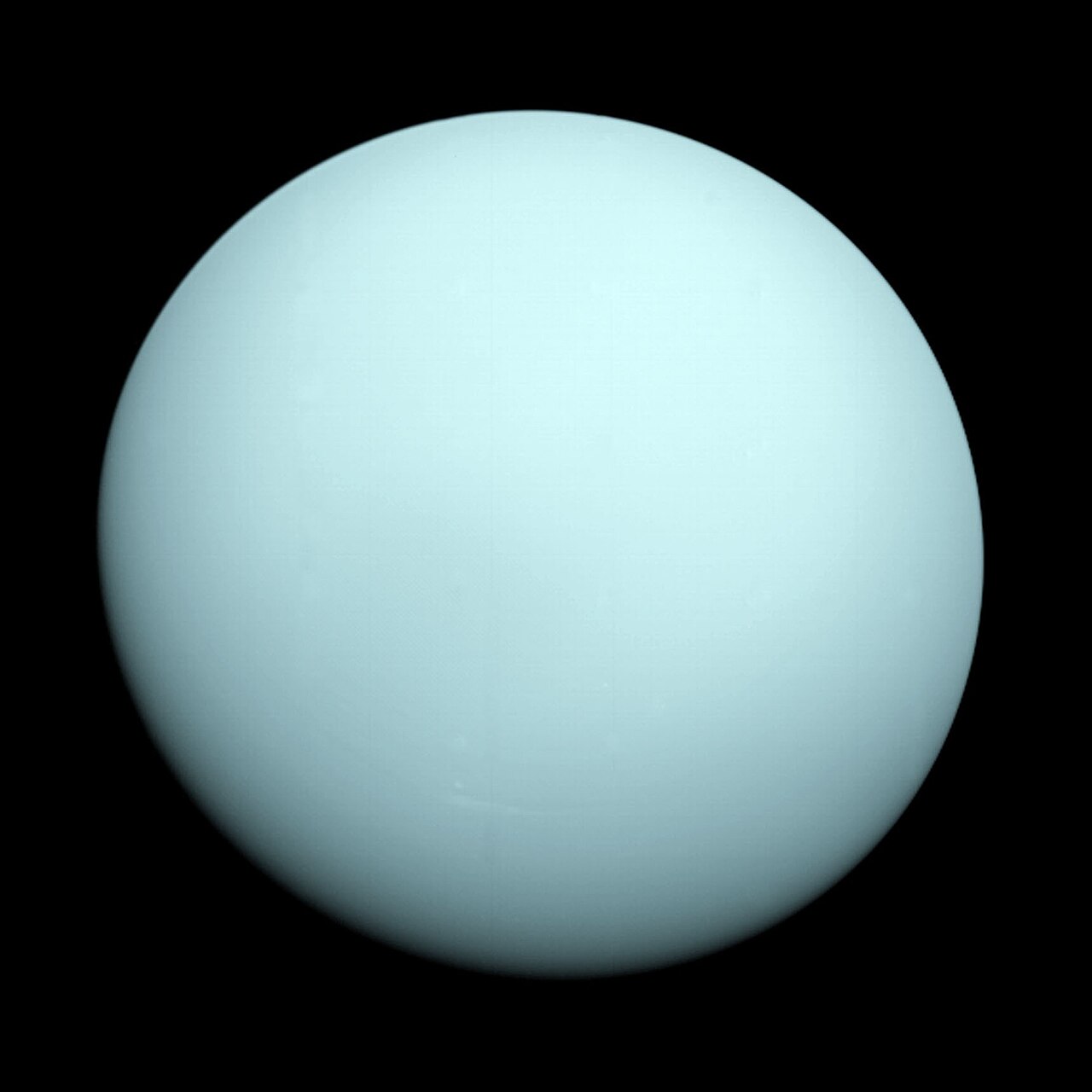 Uranus photographed by NASA's Voyager 2 spacecraft in 1986. Public domain (NASA/JPL-Caltech).
What a "transit" actually is (and what it is not)
A transit is just where a planet is in the sky right now, measured against the zodiac, compared to where the planets were at the moment you were born. Astrology treats that relationship as a symbolic clock, a way of naming seasons of life, not a force that reaches down and rearranges your week.
A transit does not make anything happen. In astrological practice it marks a theme that is available to work with. What you do with the theme is the open variable.
Hold that frame for everything below. None of these dates are predictions of events. They are invitations to pay a certain kind of attention during a certain stretch of time. Think of the difference between a weather forecast and a verdict. A forecast tells you the conditions and leaves the choices to you. With that said, here is the 2026 calendar that astrologers have been watching for years.
Saturn enters Aries, then meets Neptune (February 2026)
According to the ephemeris, Saturn moves into Aries for the long stretch on February 13, 2026, beginning a roughly two and a half year passage through the sign. Saturn is the planet astrological tradition links to structure, limits, maturity, and the slow work of building something real. Aries is the raw start, the first spark, the appetite to begin.
Then, on February 20, 2026, Saturn meets Neptune at the very first degree of Aries. This is the rare one. The two planets have not been conjunct since 1989, and not at the start of Aries in centuries. Neptune is associated with dreams, ideals, dissolution, and the places where we blur the line between vision and illusion.
Theme for reflection: where in your life are you being asked to give a dream a backbone, or to test whether a long-held ideal can actually hold weight? Saturn-Neptune is often read as the meeting of the dream and the deadline. It can feel like disillusionment, but it can also feel like maturity, the moment an ideal either gets built or gets honestly released. A concrete version of the practice: write down one ideal you have been carrying loosely, then ask whether the next step is to fund it with real effort or to thank it and set it down.
If you are in your late twenties, this lands during a chapter astrology already treats as a structural rite of passage. Our field guide to the Saturn return walks through why that window so often coincides with the urge to rebuild a life on truer foundations.
Mercury's three retrogrades in 2026
Mercury appears to move backward three times this year. Per the ephemeris, the windows are roughly February 26 to March 20 (in Pisces), June 29 to July 23 (in Cancer), and October 24 to November 13 (in Scorpio).
Worth saying plainly: Mercury retrograde is an optical effect, not a malfunction. From Earth, the planet only appears to reverse because of how its orbit and ours line up. Nothing about your devices, contracts, or travel is astronomically affected. If you want the plain-language version of why, our explainer on Mercury retrograde lays out the geometry without the doom.
Theme for reflection: astrological tradition treats these windows as good for the "re" verbs, review, revise, reconnect, repair, rather than for launching the brand new. Each 2026 retrograde sits in a water sign, which astrologers often associate with the emotional and private side of communication. A useful, low-stakes practice: when one of these windows opens, name one thing you have been avoiding finishing, and finish it instead of starting a fifth new thing. The retrograde does not enforce this. It simply offers a recurring excuse to clean up loose ends you already know about.
Uranus enters Gemini (April 25, 2026)
On April 25, 2026, Uranus moves into Gemini, a sign it has not occupied since the 1940s. Uranus completes a full loop of the zodiac in roughly 84 years, so for almost everyone alive, this is a first. The planet is associated with disruption, sudden change, invention, and the breaking of old patterns. Gemini is associated with information, language, learning, siblings and neighbors, and how we talk to each other.
Theme for reflection: the last Uranus-in-Gemini era coincided with enormous shifts in communication technology. Without predicting specifics, the symbolic theme is clear: how we exchange information may get genuinely strange and genuinely new. On a personal level, the question to hold is where you are ready to think differently, learn something off your usual track, or update a belief you have outgrown. A small experiment that fits the theme: pick one topic you assume you already understand, and spend an afternoon arguing the other side of it in good faith.
Jupiter enters Leo (June 30, 2026)
Per the ephemeris, Jupiter enters Leo on June 30, 2026, staying a little over a year. Jupiter is the planet of expansion, growth, optimism, and meaning. Leo is associated with self-expression, creativity, play, performance, and the courage to be seen.
Theme for reflection: Jupiter tends to enlarge whatever it touches, for better and for excess. In Leo, the invitation is toward bigger creative risk and warmer generosity, with the honest caution that the same energy can tip into showmanship or overreach. A grounded way to use it: pick one creative or heart-led thing you have been shrinking from, and let yourself take up a little more room with it.
This is also where the difference between your sun sign and your real chart starts to matter. A "Jupiter in Leo" forecast written for everyone is, by design, vague enough to fit anyone. If you have ever felt that the generic horoscope for your sign does not sound like you, there is a real reason for that, and the research behind it is the subject of our piece on the psychology of believing in astrology.
The lunar nodes shift to Aquarius and Leo (July 26, 2026)
On July 26, 2026, the Moon's nodes change signs, with the North Node moving into Aquarius and the South Node into Leo for about the next year and a half. The nodes are not planets. They are the mathematical points where the Moon's path crosses the Sun's path, and they are what make eclipses possible.
Astrological tradition reads the North Node as a direction of growth and the South Node as familiar, comfortable, well-worn ground we are asked to lean on less. Moving the North Node into Aquarius shifts the collective theme toward community, the group, the shared future, and away from the solo spotlight of Leo. If the language of nodes is new to you, our explainer on the North Node and South Node unpacks why this axis is read as a tension between where you have been and where you are growing.
Theme for reflection: where might "what I want for myself" need to make room for "what we are building together"? The Aquarius pull is toward the network, the cause, the contribution that outlasts any single performance. The Leo side is not the enemy here. Tradition frames the South Node as a resource you already have, in this case warmth, presence, and the ability to lead, that you are asked to spend in service of something larger rather than hoard for the spotlight. This nodal shift is also why the back half of 2026 carries eclipses in these signs, which brings us to the year's most-watched dates.
The 2026 eclipses (verified astronomy)
Eclipses are not astrological inventions. They are precise astronomical events, and the four below are confirmed by NASA.
- February 17, 2026, annular solar eclipse. A "ring of fire" eclipse, with greatest duration around 2 minutes 21 seconds.
- March 3, 2026, total lunar eclipse. Totality visible across the Pacific, eastern Asia and Australia, and parts of the Americas.
- August 12, 2026, total solar eclipse. The path of totality crosses Greenland, Iceland, parts of northern Russia, the Atlantic, Spain, and a small corner of Portugal, with a partial eclipse visible across much of the Northern Hemisphere.
- August 28, 2026, partial lunar eclipse.
Theme for reflection: astrologers often treat eclipse seasons as accelerated chapters, times when something that was already shifting reaches a turning point. The honest version of this is not "eclipses cause events." It is that eclipse seasons are a useful prompt to ask: what in my life has been quietly building toward a decision? The eclipse is the calendar reminder, not the cause. If you want the symbolic background, our note on eclipse season explains why these stretches are read as endings and beginnings rather than ordinary weeks.
Why the generic 2026 forecast feels personal (and why it can't be)
Here is the part most year-ahead articles will not tell you. A horoscope written for "all Leos" or "everyone in 2026" feels uncannily accurate for a documented reason. In 1948, psychologist Bertram Forer gave students a personality description he claimed was individually tailored (he published the result in 1949). They rated it about 4.26 out of 5 for accuracy. It was the same generic paragraph for every single person. This is the Forer effect, also called the Barnum effect: vague, broadly flattering statements feel custom-made because we fill in the specifics ourselves.
A sun-sign forecast is true the way a fortune cookie is true. It fits because it was written to fit everyone.
This is not a knock on astrology. It is the line between the part that is shared and the part that is yours. Your sun sign is just one of many factors in your chart. The placements that actually distinguish you, your Moon, your rising sign, and the houses each 2026 transit will cross, are computed from your exact birth time and birth place. Two people born the same week can have the Saturn-Neptune conjunction land in completely different houses, which is the difference between "redefine my career" and "rebuild my home life."
If you want the short version of why those three placements do most of the heavy lifting, our guide to the Big Three breaks down how the Sun, Moon, and rising sign work together, and often pull in different directions.
Curious where 2026's big transits actually land in your chart? A generic forecast can only tell you the year's themes. Run your free birth-chart reading on Destivio to see which houses Saturn, Uranus, and Jupiter are crossing for you, computed from your exact birth time and place. That is the part that is genuinely yours.
A grounded way to use a year like this
You do not need to track every degree. A simple practice carries most of the value:
- Pick the two or three transits above that name a theme already alive in your life. If "give a dream a deadline" or "take up more creative room" lands, start there.
- Watch the season, not the day. Transits work like weather, not light switches. The Saturn-Neptune theme colors months, not a single morning.
- Use the eclipse dates as check-in points, not deadlines from the universe. Ask what is ripening, then decide for yourself.
The honest promise of astrology is not prophecy. It is a vocabulary for noticing your own life more carefully, a way to ask better questions at meaningful moments. 2026 hands you a rich set of those questions. What you build from them, the dream you finally back with structure, the conversation you finally update, the creative risk you finally take, is the only forecast that was ever really yours to write.
Read these next
This is the wide angle view of 2026. How the year actually lands depends on where these transits fall in your own chart. To go deeper on the parts that matter most, start with your big three, why you might not feel like your sun sign, the Venus and Mars signals behind your relationship patterns, and, if you are in your late twenties, the Saturn return.
FAQ
Q: What are the biggest astrology transits of 2026? A: The standouts are Saturn entering Aries in mid-February and meeting Neptune at 0 degrees Aries on February 20, Uranus entering Gemini on April 25, Jupiter entering Leo on June 30, and the lunar nodes shifting into Aquarius and Leo on July 26. There are also four eclipses and three Mercury retrograde periods. Each marks a theme for reflection, not a fixed event.
Q: Will the 2026 transits change my life? A: Astrology is a symbolic language for self-reflection, not a causal force, so no transit "makes" anything happen. How a 2026 transit feels depends entirely on where it falls in your own birth chart, which is why a generic forecast can only describe broad themes. Your exact placements, computed from your birth time and place, are the part that is specific to you.
Q: When are the eclipses in 2026? A: According to NASA, 2026 has four eclipses: an annular solar eclipse on February 17, a total lunar eclipse on March 3, a total solar eclipse on August 12, and a partial lunar eclipse on August 28. The August 12 total solar eclipse crosses Greenland, Iceland, parts of northern Russia, Spain, and a corner of Portugal. Eclipses are precise astronomical events, separate from any symbolic meaning astrology assigns them.
Q: Why does my 2026 horoscope feel so accurate even though it's generic? A: That is the Forer or Barnum effect, named after a 1948 experiment by psychologist Bertram Forer, published in 1949, in which people rated a vague, one-size-fits-all personality description as about 4.26 out of 5 for personal accuracy. Broad, flattering statements feel custom-made because we supply the specifics ourselves. A real birth-chart reading is the part that is genuinely about you, because it is built from your exact placements.
Q: How many times does Mercury go retrograde in 2026? A: Three times, per the ephemeris: roughly February 26 to March 20 in Pisces, June 29 to July 23 in Cancer, and October 24 to November 13 in Scorpio. Mercury retrograde is an optical effect from Earth's vantage point and does not physically affect anything. Astrological tradition simply treats these windows as better suited to reviewing and revising than to launching something brand new.
Arpit Tripathi
Founder, Destivio · ex-Google · ex-AWS
Arpit built Destivio to bring the depth of Vedic astrology into the age of AI — making precise, personalized birth chart readings accessible to everyone.
LinkedIn →Continue reading
Saturn Return: A Late-Twenties Field Guide
Saturn return meaning, age, and survival without the doom. A grounded field guide to your late-tw…
Read →
Your Big Three, Decoded
Big three astrology meaning goes beyond a glossary. Learn to read the tension between your sun, m…
Read →Why You Don't Feel Like Your Sun Sign
Feeling like you don't relate to your zodiac sign is the most useful clue in your chart. Here is…
Read →Explore your chart
Curious what your birth chart reveals about you?
Get a personalized reading based on your birth energy — free to start.
Discover your birth energy →