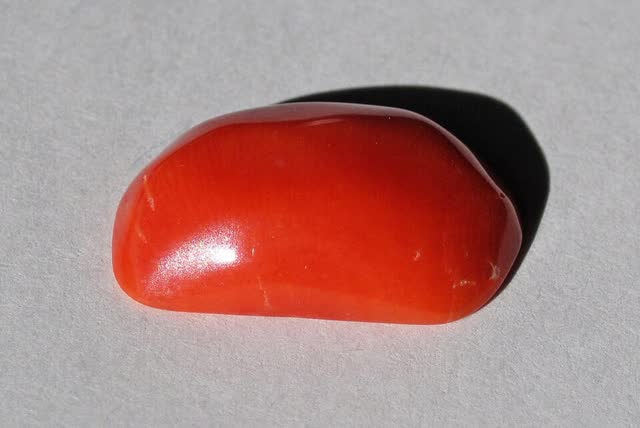
Gemstone of Mars (Mangala)
Red Coral
Moonga
Mars's stone of courage, energy and drive.
Red Coral (Moonga) is the gemstone of Mars (Mangala). A red-orange organic gem, it is traditionally linked to courage, energy and overcoming obstacles, and is the stone most associated with the Manglik (Mangal Dosha) remedy.
What is Red Coral (Moonga)?
Red coral is an organic gem formed from the calcium-carbonate skeleton of marine coral polyps, not a mineral crystal. The best astrological coral is a deep, even red and untreated. Much of the coral sold is dyed or reconstituted, so a natural, undyed stone with certification is what tradition calls for.
At a glance
Red Coral at a glance
Planet
Mars (Mangala)
Recommended for
Aries (Mesha) and Scorpio (Vrishchika) primarily; also cited for Cancer, Leo, Sagittarius and Pisces ascendants
Metal
Gold or copper
Finger
Ring finger
Day
Tuesday
Weight
Commonly 5 to 9 ratti (chart dependent)
Red Coral benefits
Everything below is what Vedic astrology traditionally believes, sorted by area of life. None of it is medical, financial or guaranteed.
Career and profession
Traditionally believed to boost focus, drive and decisiveness, favoured for the armed forces, police, sport, surgery and competitive fields.
Wealth and finances
Linked to the gains that follow courage, initiative and the removal of obstacles.
Health and body
Traditionally associated with Mars's domains of blood and vitality. This is traditional belief, not a medical claim.
Mind and emotions
Believed to build courage, confidence and assertiveness, and to reduce fear and hesitation.
Relationships
Strongly tied to the Manglik remedy: traditionally said to ease marriage delays where Mars afflicts the marriage houses.
How to wear Red Coral
Red coral is set in gold or copper, cleansed in raw cow's milk and clean water, energised by chanting the Mars beej mantra 108 times, and worn on the ring finger on a Tuesday morning.
Mars beej mantra
Om Kraam Kreem Kraum Sah Bhaumaya Namah
Traditionally chanted 108 times to charge the stone before its first wear.
How to spot a real Red Coral
- ·Natural coral has a waxy, slightly irregular surface with fine pores; a glassy, flawless surface suggests imitation.
- ·A swab of acetone or nail-polish remover will pick up colour from dyed coral; natural coral does not bleed.
- ·Tapped gently, natural coral gives a dull, muted sound, while glass or plastic rings higher.
Substitutes for Red Coral (upratna)
The traditional substitute (upratna) is carnelian, with red jasper and red agate also cited.
Who should wear it
Who it suits, and what to watch
Traditionally cautioned where Mars is unfavourable, as it is believed it may increase anger or conflict. Wear only after chart analysis by a qualified astrologer.
These are traditional astrological beliefs, not medical, financial or guaranteed outcomes. A gemstone is traditionally read off your whole birth chart, so the right stone for you comes from an actual reading.
Pick the right one
Which gemstone is right for you?
The stone that suits you tracks the planets in your birth chart, not just your sign. Destivio runs your full Vedic chart and shows which planets are strong or weak, so you can make an informed call with a qualified astrologer.
Your reading covers every area. If you want, start with what is on your mind.
Get your free reading
Red Coral FAQ
Which planet does Red Coral represent?
Red Coral (Moonga) represents Mars (Mangala). It is traditionally worn to strengthen a favourable Mars and is associated with the Manglik dosha in matchmaking.
Who should wear Red Coral?
It is traditionally recommended for Aries (Mesha) and Scorpio (Vrishchika) ascendants and others with a favourable Mars, set in gold or copper on the ring finger, on a Tuesday, after chart analysis.
What is the mantra for wearing Red Coral?
The Mars beej mantra "Om Kraam Kreem Kraum Sah Bhaumaya Namah" is traditionally chanted 108 times to energise the coral before first wear.
How can I tell if Red Coral is real or dyed?
Natural coral has a waxy, slightly porous surface and does not bleed colour onto an acetone swab. Dyed coral transfers colour, and glass imitations look too glossy and ring with a high pitch when tapped.
The nine Navratna gemstones
Related